

Windletter #116 - Giles Dickson steps down as CEO of WindEurope
Also: SGRE talks about its experience in floating, a bunch of refurbished V27 and V29, repairing a nacelle at sea, and more.


Hello everyone and welcome to a new issue of Windletter. I'm Sergio Fernández Munguía (@Sergio_FerMun) and here we discuss the latest news in the wind power sector from a different perspective. If you're not subscribed to the newsletter, you can do so here.
Windletter is sponsored by:
🔹 Tetrace. Reference provider of O&M services, engineering, supervision, and spare parts in the renewable energy market. More information here.
🔹 RenerCycle. Development and commercialization of specialized circular economy solutions and services for renewable energies. More information here.
🔹 Nabrawind. Design, development, manufacturing, and commercialization of advanced wind technologies. More information here.
Windletter está disponible en español aquí
The winner of the Best Energy Communicator award was finally Joaquín Coronado. An award that, I honestly believe, is totally well deserved.
The truth is, if I had had to bet money, I think I would have bet on him. Joaquín’s LinkedIn posts are always current, technically accurate, and generate a lot of debate in the comments section. You learn a lot from them.
As for me, I’m more than proud to have brought the name of Windletter to the final. Thank you all for making it possible. We’ll keep fighting to win the award one day!
I do regret not being able to attend the ceremony, but the truth is that coming from Bilbao on a weekday, the logistics weren’t exactly easy.
I’d also like to let you know that this will be the last Windletter news edition of the season.
But don’t worry, next week you’ll get a slightly different Windstory to enjoy while you’re at the beach, and the following week we’ll wrap up with an edition featuring personal reflections on the 2024–2025 period and what we can expect from the upcoming season.
Now yes, the most read from the last news edition was: GE obtains a permit for an 18 MW prototype, SGRE receives the first order for the new 4.X, and BloombergNEF’s installation forecasts for this year.
Also, last week we published a guest article by Pablo Carazo Morales, where we reviewed the different drivetrain configurations available in wind turbines.

Let’s go with this week’s news.
👋 Giles Dickson steps down as CEO of WindEurope
Giles Dickson has decided to leave his position after 10 years in the role. He will return home to the United Kingdom to become a school teacher.
WindEurope is now in the process of searching for a successor. In the meantime, Giles will remain at WindEurope until the end of the year.
The past 10 years have been years of consolidation for the sector in Europe. It has been a time of technological maturity, but also a period in which literally everything has happened:
Mergers and consolidations among manufacturers (Nordex and Acciona Wind Power, Siemens Wind Power and Gamesa).
The disappearance of manufacturers (Senvion).
A real financial crisis among OEMs in recent years.
The expansion and consolidation of offshore wind.
European developers and manufacturers bringing wind power around the world, followed by the beginning of a withdrawal from some of those markets.
The initial arrival of Chinese manufacturers in Europe.
The effort to protect the European industry with measures that fit within EU free market policies (some of you may remember the European Wind Power Package).
Wind power currently represents 20% of Europe’s electricity consumption. The industry generates 370,000 direct and indirect jobs, with projections to grow to 600,000 jobs by 2030, and contributes €52 billion annually to the European GDP.
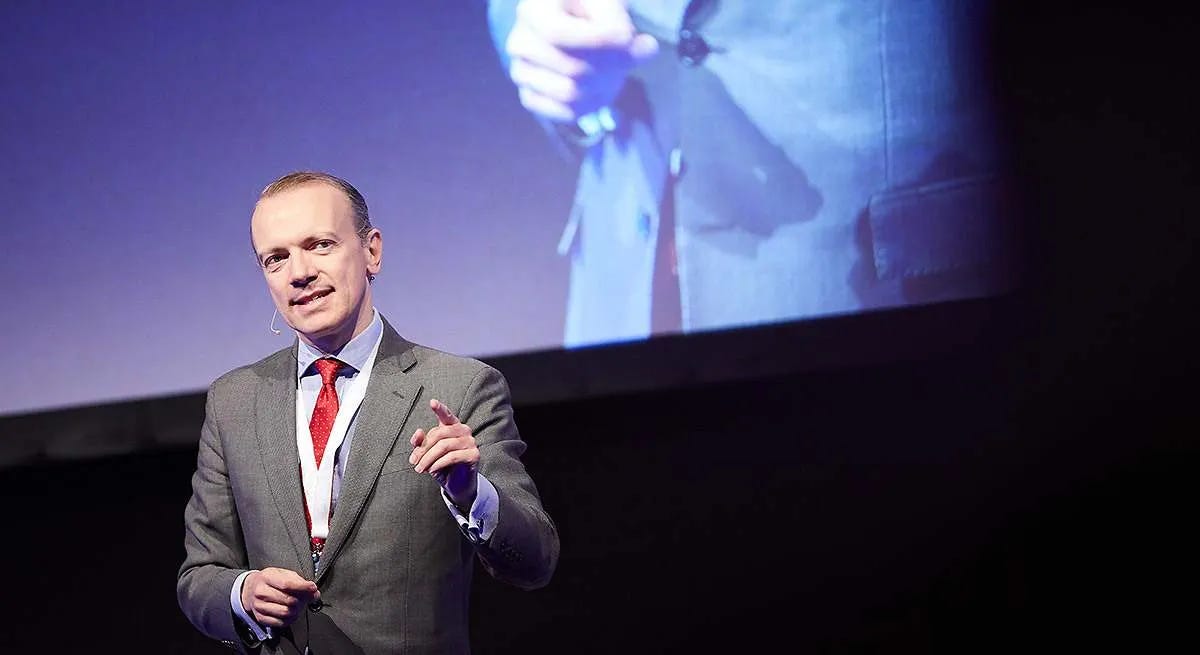
The truth is that Giles always struck me as an atypical CEO, with a special charisma, one of those people who do not go unnoticed. Someone capable of conveying passion and commitment through words.
Moreover, he speaks Spanish, something uncommon in profiles like his in the European context, but which I personally believe is worth appreciating, especially given Spain’s position in the European wind sector.
I’ve not had the pleasure of meeting him, but his farewell post on LinkedIn is a clear sign of the legacy and number of friends he leaves behind in the wind industry. Over 5,000 reactions and more than 500 comments from the sector’s most respected voices.
Giles, from Windletter we wish you the very best in your new challenges and a happy return home.

🌊 Siemens Gamesa shares its experience in floating wind at Provence Grand Large
The Provence Grand Large wind farm has become the first floating project in France and in the Mediterranean. Composed of three Siemens Gamesa SG 8.0-167 DD turbines of 8.4 MW mounted on TLP (Tensioned Leg Platform) foundations, it was recently connected to the grid.
Siemens Gamesa has decided to share more in-depth details about this project on its website (also shared by its Offshore CEO, Marc Becker), aiming to showcase its capabilities in the floating wind sector while also highlighting the challenges. This communication effort by SGRE is interesting, as floating wind had previously taken a lower profile in public messaging (or at least that’s my impression).
Until now, manufacturers haven’t had strong incentives to fully dive into floating wind. After all, it’s a relatively unknown field, and past experiences have shown maintenance challenges with the need for major corrective operations.
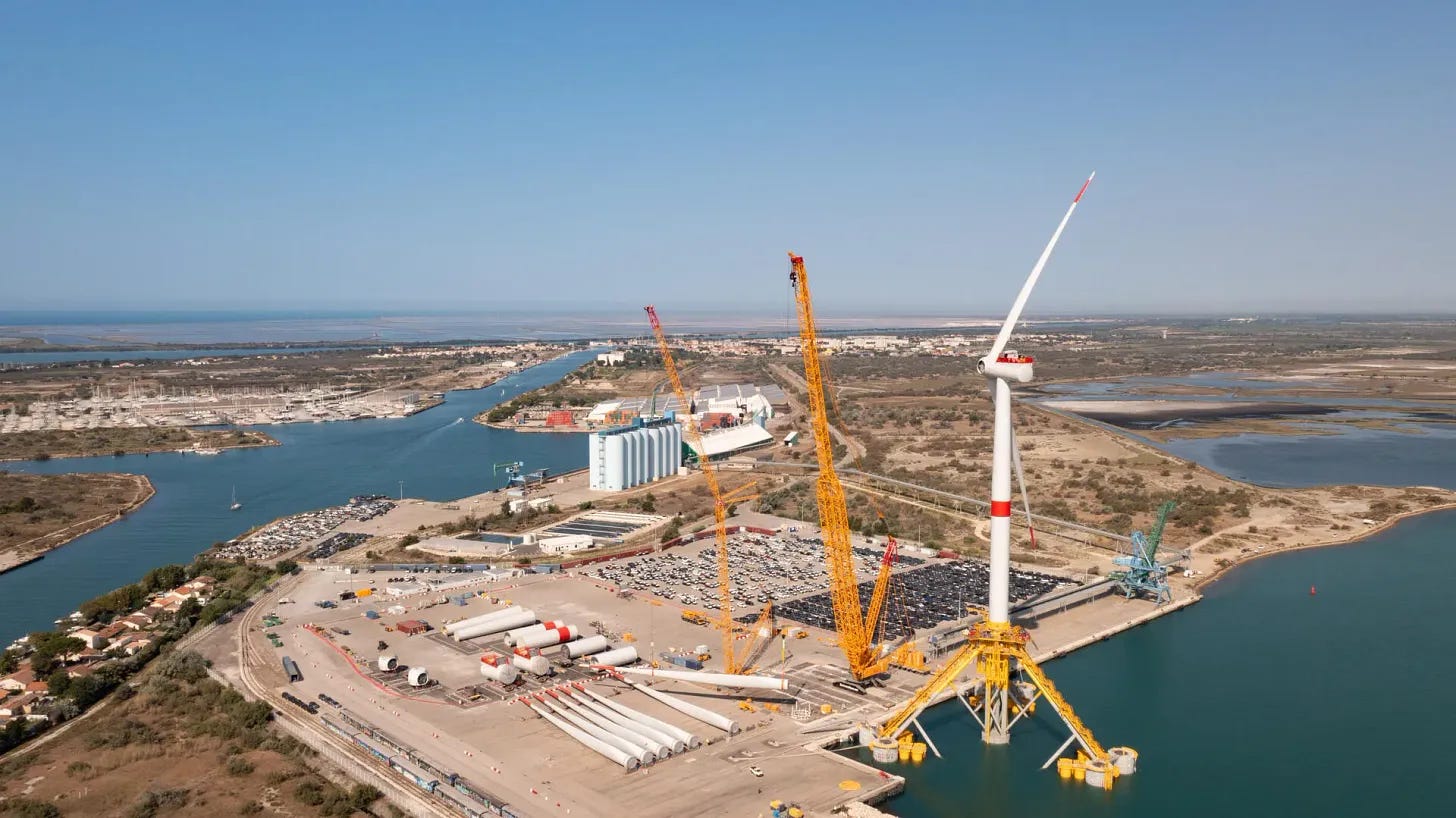
The article includes some reflections, including comments from SGRE employees. According to Malte Lembrecht, Team Lead for Floating Wind at Siemens Gamesa: “The floating wind sector is still in its early stages, and we are learning with every step.” He adds, “Our goal is to bring the technology to commercial scale. The biggest obstacle is reducing costs and proving that these systems work reliably and efficiently at a larger scale.”
One key point Malte highlights is the following:
“We’re not starting from scratch. By adapting proven bottom-fixed technologies and adjusting them for floating wind, we can accelerate development and reduce risk. This approach allows us to strike a balance between rapid deployment and the continuous research and development needed to make floating wind a viable, large-scale solution.”
This reflection ties in well with a very curious fact: all floating wind farms in which Siemens Gamesa has supplied turbines are equipped with machines of 8 MW or less. A much more tested platform and significantly smaller in size than today’s standard models.
However, times are changing, and SGRE already has a preliminary agreement to supply 750 MW of its 15 MW turbines for Bandibuli (Firefly), a wind farm located in South Korea.
A change of attitude towards floating wind among Western OEMs?

🔇 The first noise barrier made from reused blades, under test
It looks like someone heard us. A few weeks ago, we reviewed all the second-life uses wind turbine blades can have, from playgrounds to noise barriers, to urban furniture, and even bungalows.
Some of those uses were just ideas developed by someone, but never actually implemented.

News now comes from the Netherlands that a 60-metre section noise barrier will be tested under real conditions. This Blade Barrier (as it has been named) will be installed along the A58 motorway, in a test area prepared for that purpose.
Interestingly, on Google Maps you can already see what appear to be different types of acoustic barriers under test, though the blades are not yet visible.
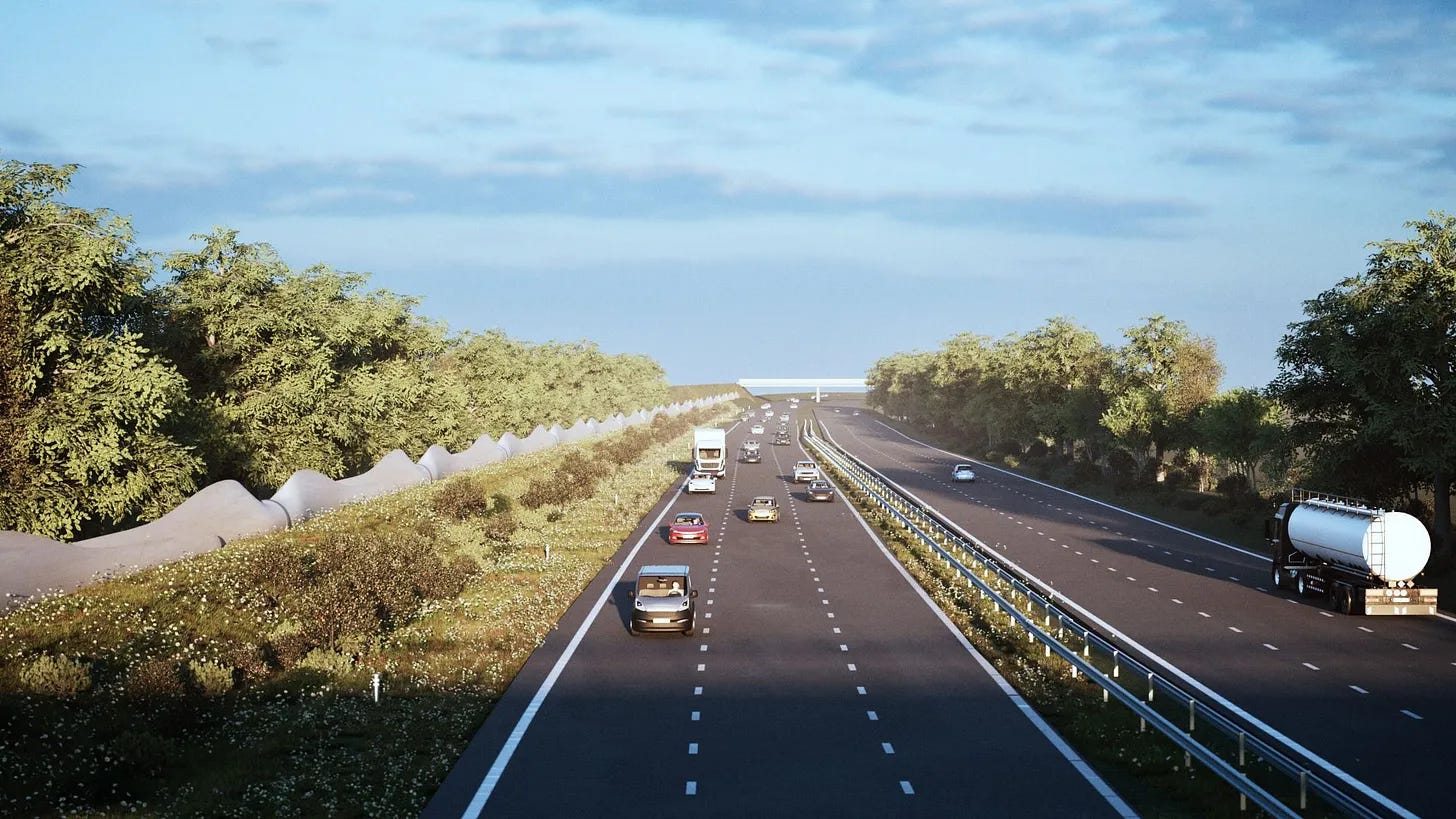
The prototype will be monitored and evaluated until the end of 2026.
Unlike those mentioned in the Windstory, in this case they have decided to use the blades whole and in a horizontal position. It’s estimated that this horizontal application requires about 45 blades per kilometre, while a vertical version would need around 200 blades per kilometre. Moreover, it doesn’t require post-processing work (although it’s unclear whether the blades have been filled with any material).
The downside, of course, is that the blade must be transported whole to the final location, where a suitable crane is needed to unload it. This makes logistics a bit more complicated.
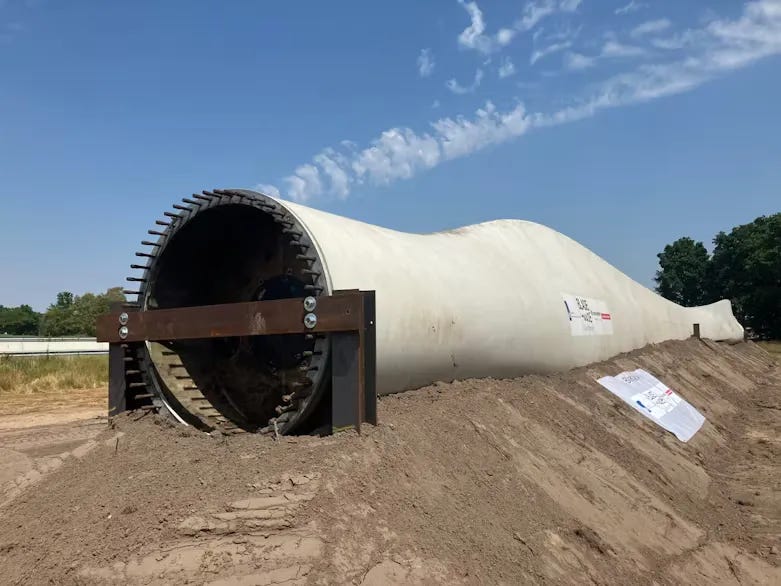
The blades, by the way, come from the Perwez wind farm (Belgium), owned by Eneco. These are GE blades from 1.5 MW turbines with a 77-metre rotor diameter and an approximate blade length of 37 metres.
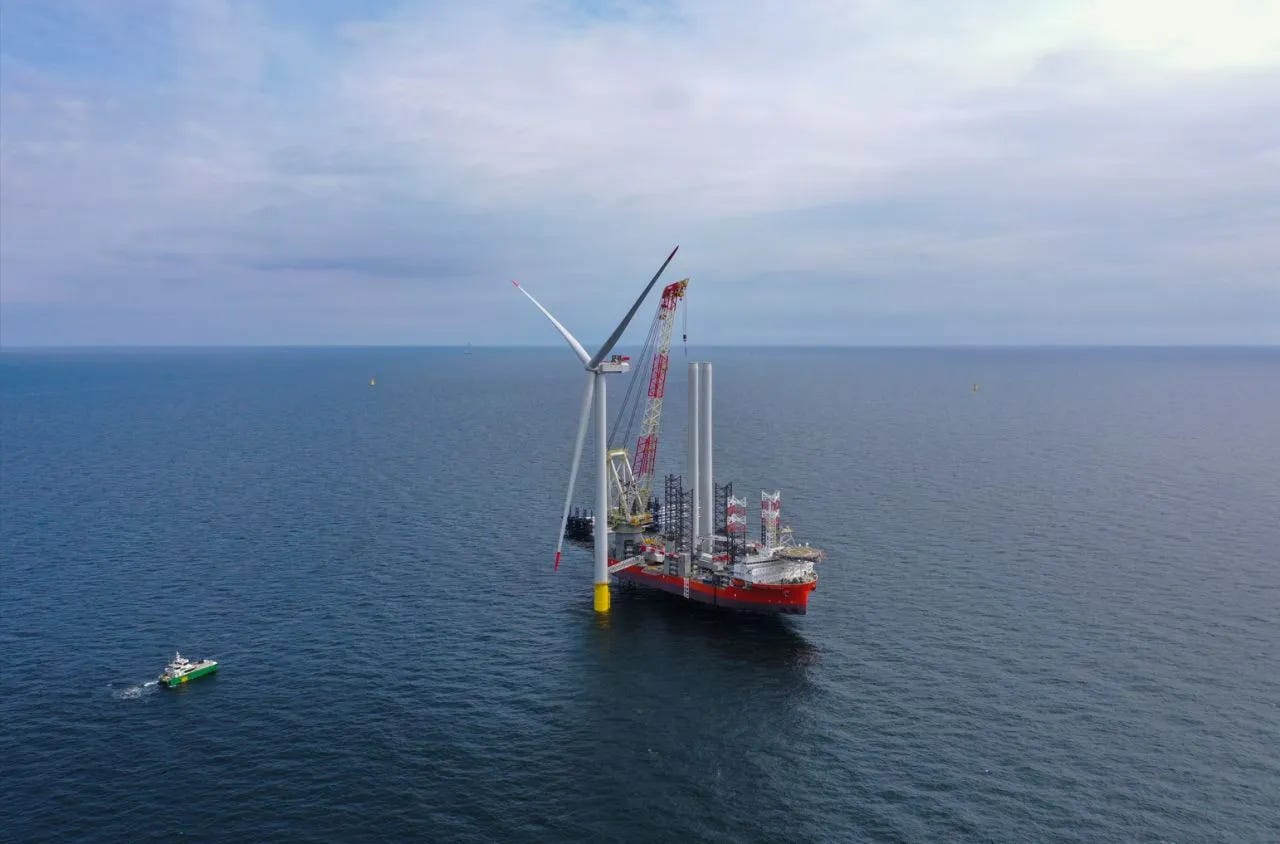
🏗️ Vestas installs the first V236-15.0 MW at Baltic Power
Vestas continues the rollout of its massive V236-15.0 MW order book with the installation of the first unit at the Baltic Power offshore wind farm, developed by ORLEN and Northland Power Inc.
With 76 turbines and a total capacity of 1.2 GW, it will be Poland’s first offshore wind farm and one of the largest in Europe.
Vestas has turned Poland into a manufacturing hub for the V236-15.0 MW, where it currently employs 1,400 people and, according to previous reports, aims to expand that to 2,500.
Let’s not forget that coal still dominates Poland’s electricity generation, and the country has made a strong commitment to offshore wind. Its target is to reach 5.9 GW of installed offshore wind capacity by 2030.
Vestas has a V236 order book of over 13 GW, including firm orders and preferred supplier agreements. According to data published by Vestas in 2023, the price of each unit is around €17 million.

🔧 A bunch of refurbished Vestas V27 and V29
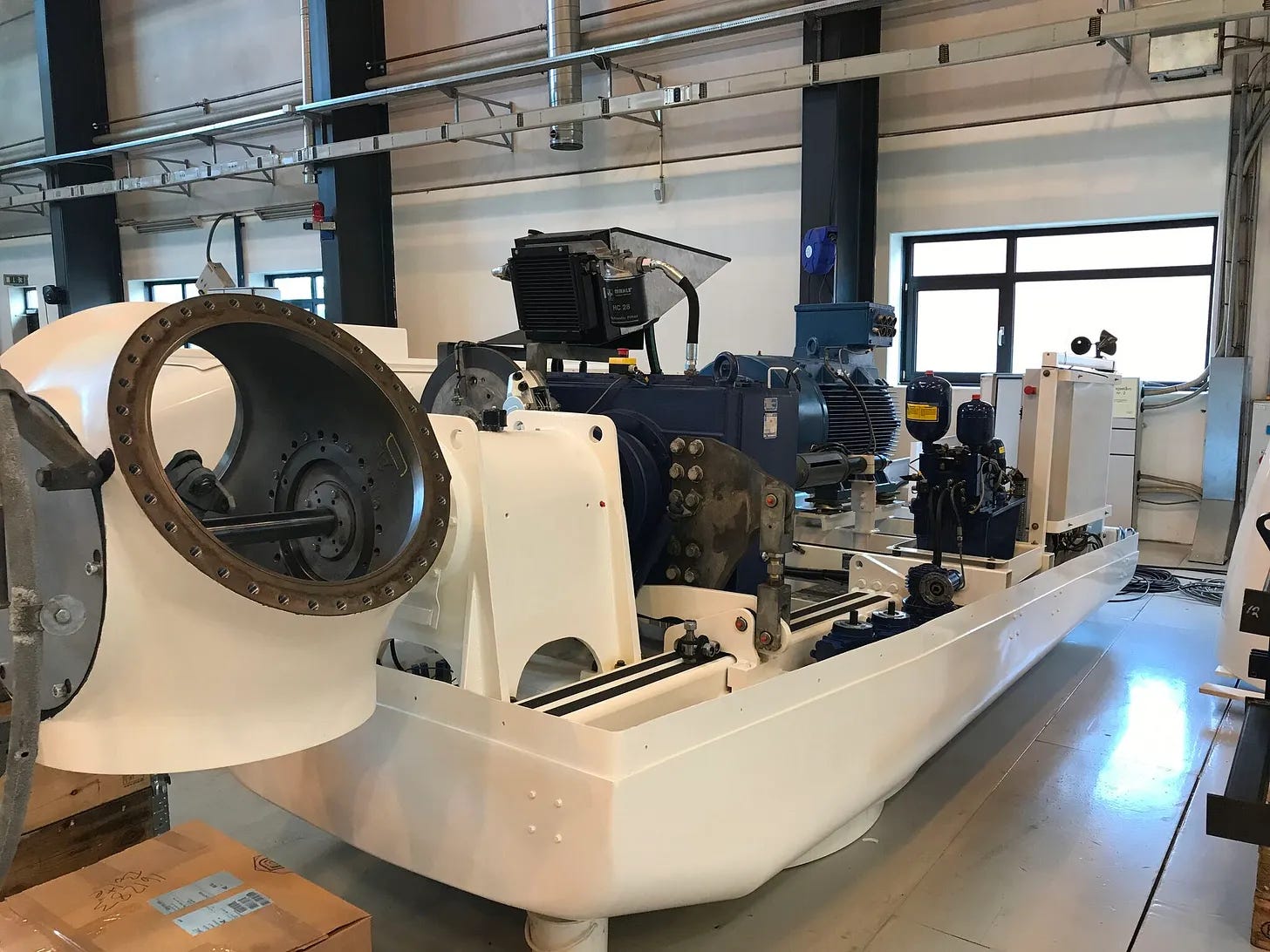
The company WindTech, which specialises in wind turbine refurbishment, has shared some beautiful photos on LinkedIn showing several refurbished Vestas V27 and V29 units.
According to their LinkedIn post, refurbishing these models is one of the most requested services they offer, especially from markets like Scandinavia, Western Europe, and the United Kingdom.
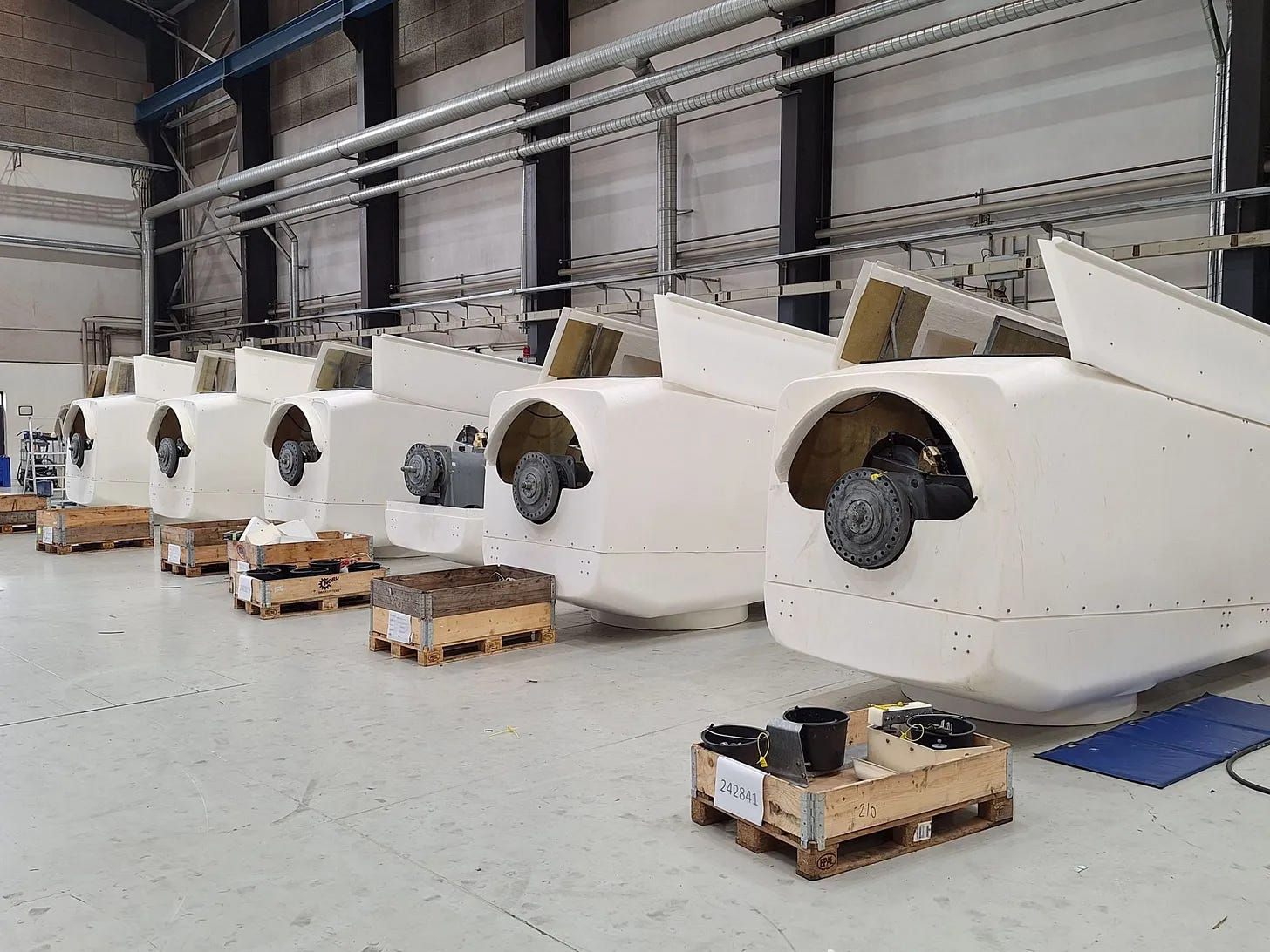
WindTech claims to have refurbished hundreds of these units over its history. That includes complete nacelles, but also main components such as gearboxes and other systems like yaw drives. According to the post, these turbines can achieve another 15–20 years of additional operation.
Personally, I love this kind of work. With the upcoming wave of repowering, we’re entering a time when many small, robust, and well-tested machines will become available, ready for refurbishment.
In my opinion, the main challenge lies in the market’s ability to absorb them. It seems unlikely that new wind farms will be built with them, but they are perfect for industrial self-consumption, energy communities, or wind farms in remote locations where large turbines don't fit (for example, Corvo Island 🙂).
What do you think?
🧪 FloatLab: DTU’s floating wind turbine test facility
DTU has unveiled one of the largest floating wind turbine test facilities in the world.
With 25 synchronised fans simulating marine turbulence, the system enables the testing of floating wind turbines of over 20 MW (scaled models, of course) in laboratory conditions, recreating extreme wind and wave scenarios. According to their statements, the facility can reach wind speeds of 42 m/s at full-scale equivalence.
Of course, the wind simulation is combined with wave generation, allowing the interaction between aerodynamics and hydrodynamics to be tested, one of the key aspects of floating wind.
In the initial trials, a variant of the TetraSub from Stiesdal Offshore was tested, using a 1:70 scale model of the 22 MW IEA reference wind turbine.
The truth is, it’s worth watching the video:
The FloatLab project is funded by Innovationsfonden and involves DTU, DHI, Siemens Gamesa, Ørsted, Stiesdal Offshore, and Stromning.
Honestly, these test benches are spectacular. Let’s see if DTU invites us for a visit someday 🙂

⛏️ Dismantling an offshore nacelle, fixing it on the vessel, and reassembling it
From China we often see some truly fascinating videos, many of them shared by Gang Wang on LinkedIn, who has become the go-to expert for the Chinese wind sector.
The latest video really caught my attention. It shows a damaged wind turbine with a broken blade. During the incident, the blade appears to have hit the nacelle, which also needs repair.
What’s remarkable, aside from some questionable health and safety practices, is that the repair is carried out directly on the vessel, without transporting the nacelle back to shore for proper servicing. Something that would be unthinkable in the West if I am not mistaken. Moreover, another ship delivers the replacement blades, which are installed as part of the same operation.
It’s worth reading one of Gang Wang’s comments to understand the differences between Chinese and Western offshore practices:
The price of this 9.225 kW wind turbine, including the tower and a 5-year warranty, is just 3,300 RMB per kW—that’s around €420/kW. In other words, roughly one-third of the cost of international offshore platforms.
So… in the end, you get what you pay for.
If any Chinese manufacturer were able to offer an offshore wind platform at 33% of the price of Vestas or Siemens Gamesa, with the same LCoE (Levelised Cost of Energy) and a 25–30 year lifetime, then Denmark should exit the offshore wind industry and let China lead it—for the common good.
Thank you very much for reading Windletter and many thanks to Tetrace, RenerCycle and Nabrawind our main sponsors, for making it possible. If you liked it:
Give it a ❤️
Share it on WhatsApp with this link
And if you feel like it, recommend Windletter to help me grow 🚀
See you next time!
Disclaimer: The opinions presented in Windletter are mine and do not necessarily reflect the views of my employer.